
Erie County Court Records After Arrest
The Erie County arrest-to-court path runs from jail intake to preliminary arraignment, prosecutor review, Magisterial District Court or Common Pleas docketing, and Clerk of Courts recordkeeping. The jail record and the court record are not interchangeable. Erie County Prison may have current custody, booking charges, bond, visits, money, mail, property, medication, and phone information. The court docket shows what charges were filed in court, what events have occurred, whether bail was entered, and how each charge was resolved.
For custody and booking questions, use the county prison channel described on the Erie County jail inmate records page. For booking photos, use the separate Erie County jail mugshots page because no official county mugshot gallery was found. Court records after a jail arrest are found through UJS Case Search, the Erie County Clerk of Courts, Magisterial District Court records, and older or non-online office searches.
Search Erie County Court Records
The Pennsylvania UJS Case Search portal is the primary online route for court records after a jail arrest in Erie County. It supports several search modes, and the county filter includes Erie. The judicial district filter includes Erie - 06. Exact identifiers such as OTN, docket number, complaint number, citation number, incident number, or SID help narrow results when a name is common.
- Confirm current or recent jail custody with Erie County Prison if the arrest was recent.
- Open UJS Case Search and choose Participant Name when no case number is known.
- Use the Erie county filter or Erie - 06 judicial district filter when the portal offers those options.
- Search by OTN, complaint number, docket number, citation number, SID, or incident number when one is available.
- Open the docket sheet and review charges, grading, bail entries, hearing dates, disposition, sentence, and costs.
- If no docket appears, allow time for processing or contact the Clerk of Courts for older or non-online records.
The UJS Case Search page shows the search modes and Erie filters used for local criminal dockets.
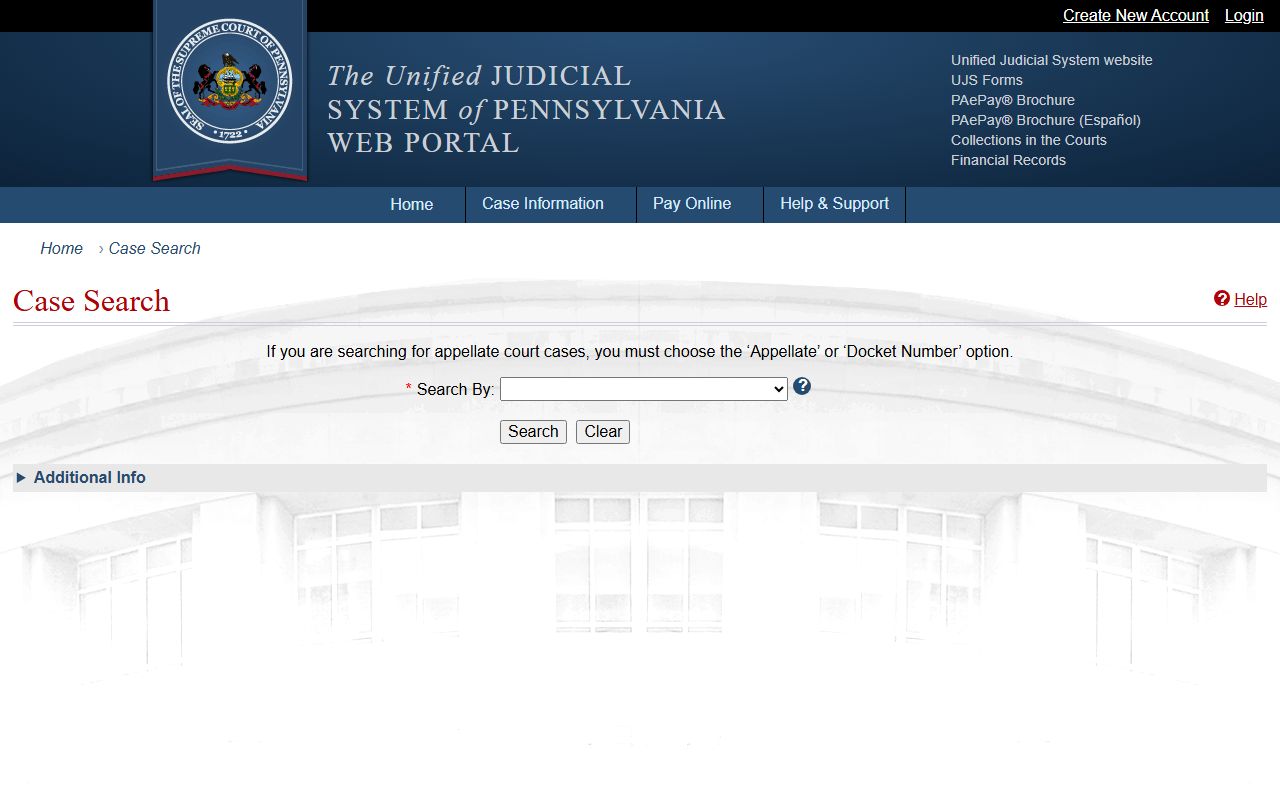
The image supports the practical search path: use statewide court records for charges and the county prison for custody status.
Erie County Court Search Fields
UJS has more structured search fields than the county jail side because Erie County does not publish a public jail roster. When the case is in court, the right filter can prevent false matches and missed dockets. Erie County Central Court and Erie County Magisterial District Judge offices may appear in MDJ office options.
| Field Label | Type | Required | Options or Format Notes |
|---|---|---|---|
| Search By | radio/choice | yes | Includes Appellate, Attorney, Calendar Event, Citation Number, Complaint Number, Date Filed, Docket Number, Incident Number, Organization, OTN, Parcel, Participant Name, and SID. |
| Docket Number | text | conditional | Use when the court docket number is already known. |
| Date Filed Start / End | date | optional | Limits the search to a filing date range. |
| County | dropdown | optional | Select Erie when searching county-level Pennsylvania court records. |
| Judicial District | dropdown | optional | Select Erie - 06 when available. |
| MDJS Court Office | dropdown | optional | Includes Erie County Central Court and Erie County MDJ offices. |
Charges Filed After Arrest
The charge record begins when police, the prosecutor, or the court paperwork moves beyond booking. The Erie County District Attorney is the local prosecutor for felony, misdemeanor, and summary offenses. The District Attorney's Office can file, amend, reduce, dismiss, or replace charges as the case moves through the system. Booking charges may be a starting point, not the final court record.
| Document | Who Files It | What It Does |
|---|---|---|
| Complaint | Police or prosecutor through the court process | Starts or supports the case and identifies alleged offenses tied to the arrest. |
| Information | Prosecutor | Formal charging document used after review, often in Common Pleas criminal cases. |
| Indictment | Grand jury process where used | Formal accusation for serious matters when that procedure applies. |
The Erie County DA Crimewatch page may publish arrests, cases, warrants, most-wanted items, and public-safety announcements, but those posts are not complete docket sheets. UJS and the Clerk of Courts are the court-record channels.
Erie County Charge Status
Charge status can change after an Erie County arrest. A booking description can be amended when the prosecutor files formal charges. Some charges are reduced, withdrawn, dismissed, or resolved by plea, verdict, or sentence. A docket should be read by charge, not only by case caption, because one case can include several charges with different outcomes.
| Status | What It Means |
|---|---|
| Pending | The charge remains open and no final disposition has been entered. |
| Amended or reduced | The prosecutor or court record changed the charge, grading, or count from an earlier version. |
| Dismissed | The charge was not carried forward or was ended by the court. |
| Nolle prosequi | The prosecution declined to proceed on that charge, subject to the docket entry and court action. |
| Guilty plea or conviction | The charge ended in a plea or finding of guilt and may lead to sentence entries. |
| Sentence imposed | The court entered punishment or supervision terms, which may affect county jail or PA DOC placement. |
Bail After Erie County Arrest
Erie County Prison provides bond amounts and policies by phone when the information is releasable. Pennsylvania Rule of Criminal Procedure 540 ties preliminary arraignment to charges, bail, counsel, and notification. If a defendant is detained after preliminary arraignment, the defendant has an opportunity to post bail. If bail is not posted, or if another hold controls custody, the person can remain in jail.
| Bond Type | How It Works |
|---|---|
| Monetary or cash bail | A set amount must be posted or secured before release. Verify payment location and method with the jail or court. |
| Unsecured bail | The defendant may be released without depositing the full amount but owes money if conditions are violated. |
| Recognizance | Release based on a promise to appear and comply with court rules. |
| Non-monetary conditions | Reporting, no-contact terms, travel limits, treatment, or other court conditions may apply. |
| No release or detainer | Another warrant, probation or parole detainer, federal hold, or ICE hold can block release despite local bail. |
Note: Bond shown on a court docket should still be checked with the jail or court before anyone attempts payment.
Erie County Clerk Records
The Erie County Clerk of Courts is the custodian of Erie County criminal court records. The office handles motions, pleadings, transcripts, and other filings tied to criminal cases. The courts directory lists Clerk of Courts Criminal Records at Erie County Courthouse, Room 103, 140 West Sixth Street, Erie, PA 16501, phone 814-451-6221, email clerksrequests@eriecountypa.gov, Monday through Friday, 8:00 a.m. to 4:30 p.m.
The Erie County record information page says a person may independently search records in the office. If the Clerk of Records conducts the search, the fee is $20. That matters for older court records, non-online material, or searches where UJS does not show the needed case.
Warrants and Court Records
A warrant can lead to an Erie County arrest, but a warrant listing is not the same as a jail custody record or a full court docket. The Erie County Sheriff's Office handles warrant enforcement as part of its court and public-safety duties. Its public warning says callers pretending to be deputies have threatened citations or contempt unless money is paid, and the office instructs the public to verify warrant calls at 814-451-6007.
The Erie County District Attorney Crimewatch page has warrants, arrests, cases, most wanted, submit tip, crime map, broadcasts, events, and news features. It is an official public-safety source, not a complete court-record index. Bench warrants may also appear as docket events in UJS Case Search.
Charges vs Convictions
An Erie County arrest and charge do not prove guilt. A charge is an accusation or filed count that must move through the court process. A conviction is a final result based on a guilty plea, verdict, or qualifying disposition. Dockets can show both dismissed counts and convicted counts in the same case.
| Point | Charge | Conviction |
|---|---|---|
| Stage | Accusation after arrest or prosecutor filing | Final guilty plea, verdict, or qualifying judgment |
| Proof | Based on probable cause or charging review | Based on plea or proof beyond a reasonable doubt |
| Docket impact | May be pending, amended, reduced, or dismissed | May support sentence, costs, supervision, jail, or DOC placement |
Sealed vs Expunged Records
Pennsylvania court records can be limited, sealed, or expunged only through legal rules and court action. The Pennsylvania Right-to-Know Law does not override every criminal-record limit. CHRIA defines criminal history record information and investigative information, and 18 Pa.C.S. § 9122 governs expungement eligibility for qualifying criminal-history records.
| Point | Sealed or Limited Access | Expunged |
|---|---|---|
| Public view | Hidden or limited from public access in qualifying circumstances | Removed or treated as no longer available through the normal record path |
| Agency access | Some justice agencies may still retain access depending on law | Access is narrower and depends on the expungement order and statute |
| How it happens | By court rule, statute, order, or qualifying limited-access process | By petition or procedure under Pennsylvania expungement law |
Important: This site is not a consumer reporting agency, and casual web lookups are not a substitute for FCRA-compliant background screening.
Restricted Erie County Court Records
Some court records after an arrest may not be public. Juvenile matters, sealed records, expunged records, criminal-investigative material, victim information, mental-health material, and security-sensitive content may be withheld or redacted. The Right-to-Know Law creates a written request process and a presumption of access for public records, but it also includes exemptions such as criminal-investigative records. If a county agency does not hold the requested police report or arrest material, Erie County may direct the requester to the proper municipality or authority.